Albania’s UNESCO World Heritage Sites and Ancient Wonders: A Guide for the Culturally Curious
Albania doesn’t shout about its history. It doesn’t need to. From the perfectly preserved Ottoman streets of Berat to the layered ruins of Butrint – Greek, Roman, Byzantine and Venetian all in one extraordinary place. The country carries its past with a quiet confidence that rewards those who look carefully.
For a nation of under three million people, Albania’s cultural and historical footprint is remarkable. Two UNESCO World Heritage Sites, one of the most significant ancient archaeological sites in the Balkans, a medieval island monastery that looks like it was designed by someone who had seen too many paintings of paradise, and a Roman amphitheatre hiding in plain sight in the middle of a residential neighbourhood. All largely undiscovered by the international crowds that have long since descended on Dubrovnik, Athens and Rome.
That won’t last forever. Here’s your guide to the cultural sites that make Albania genuinely unmissable and why you should go before everyone else does.
Planning a cultural tour of Albania? We’ve been doing this since 1993 and know these sites better than almost anyone. Get in touch for a free, no-obligation conversation about your itinerary.
Berat: The City of a Thousand Windows
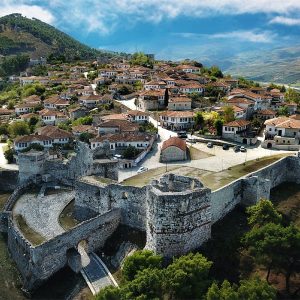
If Albania has a single image that defines it in the mind of the culturally curious traveller, it is probably Berat at dusk. The distinctive Ottoman houses climbing the hillside above the Osum River, their rows of arched windows catching the fading light, the castle sitting proudly above it all. It is one of those views that stops you mid-sentence.
Berat was awarded UNESCO World Heritage status in 2008, recognised as an outstanding example of a well-preserved Ottoman town. It is one of the oldest cities in Albania, with evidence of settlement dating back to the 4th century BC, though the town that exists today, with the old quarters of Mangalem and Gorica on either bank of the river, is predominantly Ottoman in character.
The castle, Kalaja e Beratit, is one of the most remarkable in the Balkans. Still inhabited today, families live within its walls, it contains Byzantine churches, Ottoman mosques and the extraordinary Onufri Iconography Museum, home to one of the finest collections of Byzantine and post-Byzantine icons in the world. Onufri himself was a 16th century Albanian master painter whose vivid, almost luminous use of red pigment set him apart from his contemporaries and whose work has stood the test of five centuries without losing any of its power.
Berat rewards those who give it time. Two nights minimum. Three if you have them. The guided walk through Mangalem, an afternoon in the castle, a morning at the Onufri Museum and an evening in one of the restaurants in the old town are a combination that very few places in Europe can match at any price point.
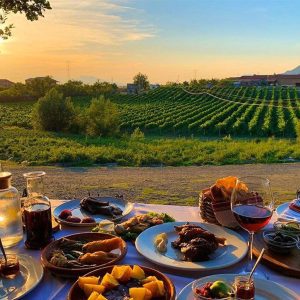
Berat has also emerged as Albania’s food and wine capital, with outstanding local restaurants that take genuine pride in their cuisine and a cluster of excellent wineries in the surrounding countryside. The bold, characterful Shesh i Zi grape variety is very much at home here, and a visit to the Alpeta Winery, one of our firm favourites, makes for a memorable afternoon in beautiful rural surroundings. If wine and food are important to you, Berat will exceed every expectation.
Combine it with the Bogova Waterfall or the Osumi Canyon for one of the most complete single-destination experiences in Albania.
Gjirokastër: The City of Stone
Albania’s second UNESCO World Heritage Site sits in the mountains of the south, and it couldn’t be more different from Berat. Where Berat is warm and golden, Gjirokastër is austere and dramatic. Built from dark grey stone, climbing steeply up a hillside, dominated by a vast castle that looms over the town like something from a different century entirely. Which, in many ways, it is.
Gjirokastër received UNESCO recognition in 2005, acknowledged as a rare example of a well-preserved Ottoman town. The kulla houses, the distinctive multi-storey stone towers that line its steep cobbled lanes, are unlike anything else in the region. Many of them have been converted into boutique hotels, giving you the rare opportunity to actually sleep inside the UNESCO heritage. We’d highly recommend it.
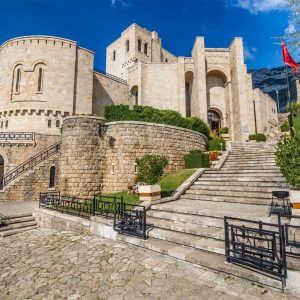
The castle is extraordinary. It houses the National Ethnographic Museum and a military museum featuring, most memorably, the wreckage of an American military aircraft. A Cold War relic that somehow perfectly captures the strange and isolating history of Hoxha’s Albania. The Cold War tunnel beneath the castle adds to that sense of a country that spent decades behind a curtain the rest of the world barely knew existed.
Gjirokastër is also the birthplace of two of Albania’s most famous sons – Ismail Kadare, the novelist and Nobel Prize candidate, and Enver Hoxha, the communist dictator who shaped (and scarred) Albania for decades. The tension between those two legacies runs through the city like a fault line, and it makes for a fascinating place to explore with a good guide.
A night here is the minimum. Two is better. The town comes alive in the evenings – the cafés along the old bazaar are excellent and the views over the valley are something else entirely.
Butrint: Layers of Civilisation in a Lakeside Setting
Of all the cultural sites in Albania, Butrint may be the one that most consistently leaves visitors speechless. It is not the most dramatic in appearance and there is no single jaw-dropping moment. Instead, Butrint works on you gradually, as the scale of what you are looking at becomes clear.
This is a site that has been continuously occupied since at least the 7th century BC. Greek colonists established a sanctuary here dedicated to Asclepius, the god of medicine. The Romans expanded it into a significant city – Julius Caesar used it as a military base, and Augustus later sent veterans here to settle. The Byzantines built churches. The Venetians built towers and walls. And then, slowly, the site was abandoned, swallowed by the surrounding wetlands, and largely forgotten.
That forgetting is, in retrospect, something of a gift. Butrint is extraordinarily well preserved. The Greek theatre, cut into the hillside, still stands. The Roman baptistery, one of the largest in the world and containing a spectacular mosaic floor, is remarkable. The city walls, the forum, the triumphal arch, the Venetian tower – all of it accumulated over more than two millennia, sitting in a strikingly beautiful lakeside setting just a few kilometres from the Greek island of Corfu.
Butrint became a UNESCO World Heritage Site in 1992. It deserves a full morning – arrive early if you can, before the day trips from Sarandë arrive, and take a guide. The site repays knowledge. What looks like a collection of old stones becomes, with the right context, one of the most vivid windows into the ancient world you’ll find anywhere in Europe.
Apollonia: The Forgotten City
Less visited than Butrint, and arguably even more atmospheric for it, Apollonia is one of Albania’s most underrated historical sites. Founded by Greek colonists from Corinth in 588 BC, it grew into one of the most important cities in the ancient Illyrian and later Roman world. Julius Caesar himself praised it as a great and noble city, and sent the young Octavian (later Augustus) here to study, a decision that would shape the Roman Empire.
At its height, Apollonia had a population of around 60,000. Today, what remains sits quietly on a low hill near the modern town of Fier, overlooking the plain below. A scattering of extraordinary ruins including a well-preserved temple of Ares, a bouleuterion (council chamber) with its columns still standing, a monumental arch, and a Byzantine monastery built, with characteristic practicality, using stone from the ancient buildings around it.
There is a small but excellent museum on site. The setting, surrounded by olive trees, with views over the surrounding countryside, is genuinely lovely. Apollonia rewards a couple of unhurried hours and sits conveniently on the road between Berat and Vlorë, making it a natural and highly recommended stop on any south Albania itinerary.
Zvernec Monastery: The Island at the End of the Causeway
Not UNESCO listed, but culturally unmissable. Zvernec Monastery sits on a small wooded island in the Narta Lagoon, just north of Vlorë, connected to the mainland by a long wooden causeway that crosses the still water of the lagoon. It is one of the most atmospheric places in Albania and that is saying something.
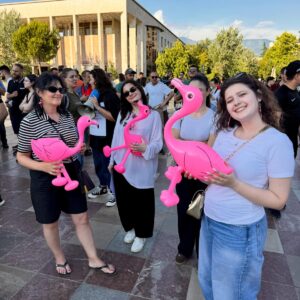
The monastery dates from the 13th century, built by the Byzantine rulers of the Despotate of Epirus on a site that may have had a religious significance long before Christianity arrived. The church of St Nicholas is the centrepiece – simple, ancient and profoundly peaceful. The surrounding lagoon is a protected nature reserve, home to flamingoes, pelicans and a remarkable variety of migratory birds, including the famous flamingoes that have become a symbol of the environmental movement that emerged here in recent years.
The walk across the causeway itself is part of the experience – the lagoon on both sides, the distant mountains of the Riviera ahead, the monastery emerging from the trees at the end. It takes about ten minutes and it is one of the most quietly beautiful walks in Albania.
Durrës Amphitheatre: Ancient Rome in a Residential Street
One of the most surreal cultural experiences Albania offers is also one of the most accessible. The Roman Amphitheatre of Durrës sits in the middle of a modern residential neighbourhood, half-buried beneath the surrounding buildings, almost incongruously vast.
Built in the 2nd century AD, it is one of the largest Roman amphitheatres in the Balkans, originally capable of holding up to 20,000 spectators. The discovery of its scale was gradual: much of it was built over during the communist era, and parts of it are still beneath the houses and streets around it. What is visible today – the outer walls, the seating terraces, the floor of the arena, and the remarkable early Christian chapel built into one of the internal corridors – is extraordinary, and the fact that it sits so casually within the fabric of a living city makes it somehow more remarkable, not less.
Durrës often gets passed over in favour of a quick drive to Tirana. That’s a mistake. The amphitheatre alone is worth a stop, and the broader city – the Venetian Tower, the city walls, the excellent Archaeological Museum – adds considerable depth to what can easily be a half-day exploration.
Planning a Cultural Tour of Albania
The sites above are not destinations you visit in isolation. They connect naturally into a south Albania itinerary that moves from Tirana through Durrës, Apollonia, Berat, Gjirokastër, Butrint and Sarandë, then north along the Riviera through Zvernec and Vlorë. With a private guide and driver throughout, each site gains the context it deserves and the journey between them, through some of the most beautiful countryside in the Balkans, becomes part of the experience.
At Experience Albania, we’ve been creating cultural tours of Albania since 2013. Our guides know these sites intimately: not just the dates and the facts, but the stories, the details and the human connections that bring a place to life.
📞 0203 822 0299
✉️ info@experiencealbania.co.uk
🌐 www.experiencealbania.co.uk